
Slab leak and pipe leak water damage in Los Angeles
A slab leak in Los Angeles is a water line leaking under the concrete floor, and LADWP's rules make every pipe after the meter the owner's. Close the house valve, call LADWP at 1-800-DIAL-DWP if it won't turn, then get the floor and walls dried within 48 hours, before clean water turns into a mold job.
Your call is connected with an independent local company. Water category: category 1 (clean water) when it comes from a supply line and is caught within a day or two.
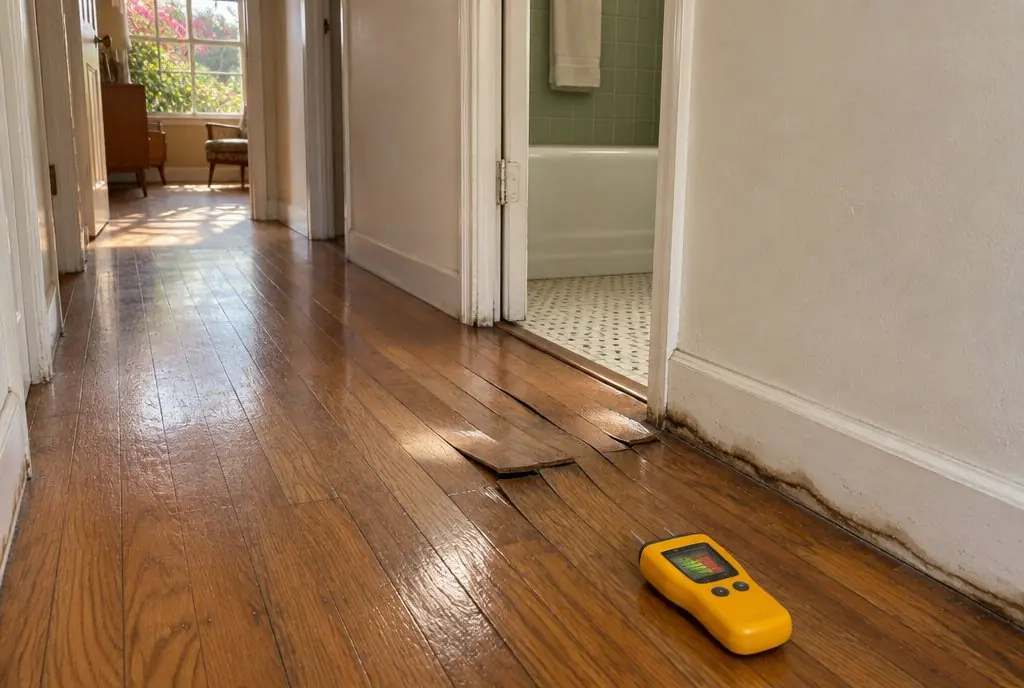
Illustrative photo.
Supply-line water starts out clean, which helps: drywall, baseboards and even hardwood can often be dried in place if drying begins in the first day or two. Water heater leaks are the other common source here, and California law requires every residential water heater to be strapped against earthquakes, because one that tips can tear its own supply line.
The job, side by side
What the company does
- 1Stop and find the leakA plumber finds the line under the slab or in the wall and repairs or reroutes it; drying can start while that is planned.
- 2Measure the wet areaMoisture readings in the floor, baseboards and lower walls set the drying plan and show what can stay.
- 3Extract and open upStanding water is pulled out, baseboards come off, and small holes or a strip of drywall may be cut to let walls breathe.
- 4Dry with equipmentAir movers and dehumidifiers run for several days; hardwood may need a mat system that pulls water up through the boards.
- 5Check before rebuildingReadings are taken again until materials reach normal levels, then flooring and drywall are repaired.
What you do right now
- 1Close the house shutoff valve, usually where the line enters the house or at a valve near the front wall. If you can't find it or it won't turn, LADWP will close the valve at the meter day or night: 1-800-DIAL-DWP.
- 2For a water heater, turn off its cold supply valve and the gas or the breaker before you touch anything else.
- 3Turn off power to any room where water is near outlets or cords.
- 4Pull rugs and furniture off the wet floor and open closet doors so air can move.
- 5Write down when you first saw water and photograph each wet spot with the date showing, for your own records.
Then: look the company up on the Contractors State License Board site before anyone opens a wall: work of $1,000 or more, or work that needs a permit, requires a California contractor license (Contractors State License Board: Check a License).
Los Angeles facts for this problem
LADWP takes water trouble calls at 1-800-DIAL-DWP (1-800-342-5397), and says representatives are available 24/7.
Source: LADWP: Power Outage / Water Trouble.
LADWP's rules say its control and responsibility end at its shut-off valve or meter, and that it is not liable for water from burst pipes, faulty fixtures or appliances on the property.
Source: LADWP: Rules Governing Water and Electric Service (Oct 2008, as amended through Resolution 019 201).
Every LADWP service connection has a control valve on the street side of the meter, and LADWP says it will operate that valve day or night for an emergency if asked.
Source: LADWP: Rules Governing Water and Electric Service (Oct 2008, as amended through Resolution 019 201).
California Health and Safety Code 19211 requires every new, replacement and existing residential water heater to be braced, anchored or strapped against earthquake motion.
Unprotected pipes start to freeze at about 20°F outside (IBHS, quoted by the ICC); the coldest night at the downtown station since 1877 was 28°F.
Source: ACIS daily record, Los Angeles Downtown (USC campus), the city's official NWS climate record, calculated by Los Angeles Water Damage & Mold on November 18, 2026.
The median home in each of ZIPs 90014, 90021 and 90062 was built in 1938, the oldest median among the Los Angeles ZIP codes on this site (Census ACS 5-year).
Source: U.S. Census Bureau, ACS 5-year, tables B25034 and B25035, calculated by Los Angeles Water Damage & Mold on November 14, 2026.
Everything after LADWP's meter is yours: the department's own rules say its responsibility ends at its shut-off valve or meter. LADWP will close the valve at the meter day or night if you ask, and it tells customers to put a second valve on the line between the meter and the house. The number is 1-800-DIAL-DWP.
Sources: LADWP: Rules Governing Water and Electric Service (Oct 2008, as amended through Resolution 019 201); LADWP: Power Outage / Water Trouble
Related on this site: the printable water emergency sheet for LADWP's 24/7 line and the valve steps on one page, and the Los Angeles water damage insurance guide for how a sudden leak and a slow one are usually treated.
How insurance usually treats it
A homeowners policy usually covers sudden water damage from a pipe that bursts or a water heater that fails, and often excludes the cost of finding and repairing the pipe itself. Leaks that ran slowly for weeks are a common reason coverage is limited. Your declarations page and the water damage section of your policy say which applies to you.
General information, not insurance advice. Your policy decides. See the Los Angeles water damage insurance guide for California's claim rules.
What changes the size of the job
- How many square feet of floor and wall got wet
- Whether hardwood, laminate or carpet is involved
- How long the water ran before it was found
- Whether the plumber has to cut the slab or reroute the line
- How many rooms need equipment and for how many days
Prices aren't on this site: the company takes moisture readings in the house and writes up an itemized estimate, and the water damage estimator lists what that estimate should include.
Questions people ask
Who pays for a leak between the meter and my house in Los Angeles?
The owner. LADWP's rules say its control and responsibility end at its shut-off valve or meter, and that it is not liable for water from burst pipes or fixtures on the property. LADWP also tells customers to put a valve on the line between the meter and the building.
What gives a slab leak away?
A warm patch in the floor when a hot water line is leaking, flooring that cups or lifts, damp baseboards with no plumbing nearby, the sound of water running when every tap is off, or a water meter that keeps turning with nothing on.
Does my water heater have to be strapped?
Yes. California Health and Safety Code 19211 says all new, replacement and existing residential water heaters must be braced, anchored or strapped to resist falling in an earthquake, and a seller has to certify it in writing.