
Mold remediation in Los Angeles
Mold remediation in Los Angeles means cutting out mold-damaged material, cleaning what can stay, and fixing the leak or damp that fed it. California has no mold license, so check that the company holds a contractor license from the state board, get a written contract, and know that a down payment is capped at $1,000 or 10 percent.
Your call is connected with an independent local company. Water category: depends on the water that fed it; mold from sewage or storm runoff starts from category 3.
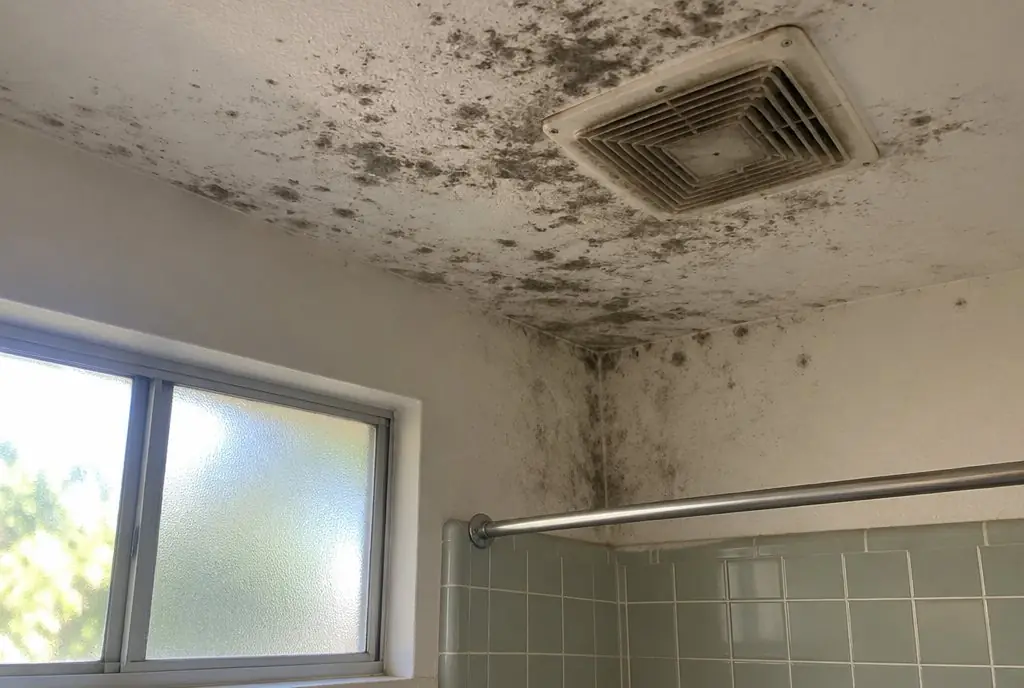
Illustrative photo.
In this city mold usually follows a slow leak rather than a flood: a supply line inside a bathroom wall, a water heater closet, a roof that let in the first storm of the season. Visible spots are usually smaller than what sits behind them, so ask how the company will find the edge of the damage before it writes the job up.
The job, side by side
What the company does
- 1Find the moistureA moisture meter and a thermal camera show how far the wet goes behind the visible spots, and where it's coming from.
- 2Set up containmentPlastic sheeting and an air scrubber with a HEPA filter keep spores from spreading to clean rooms while material comes out.
- 3Remove and cleanMoldy drywall, insulation and carpet pad are cut out and bagged; framing and hard surfaces are cleaned and dried.
- 4Dry and confirmDehumidifiers bring the materials down to normal readings, and the company should show you the numbers before walls are closed.
- 5Fix the causeThe leak, the missing fan or the gap in the roof gets repaired, or the mold comes back.
What you do right now
- 1Find the water first. A small spot that keeps growing means the leak is still running.
- 2Don't scrub or dry-brush mold on drywall; it puts spores in the air and the wall usually has to come out anyway.
- 3Run the bathroom fan and open a window when the air outside is drier than inside (today's downtown dew point is on the rainfall page).
- 4Keep anyone with asthma or a weak immune system out of the room.
- 5Take dated photos of the spots and the leak for your own records.
Then: look the company up on the Contractors State License Board site before anyone opens a wall: work of $1,000 or more, or work that needs a permit, requires a California contractor license (Contractors State License Board: Check a License).
Los Angeles facts for this problem
The California Department of Public Health says there is no legal requirement in California for training, licensing or certification of mold assessors or mold remediators.
Source: California Department of Public Health: Frequently Asked Questions about Mold.
California's contractor law applies to any job of $1,000 or more in labor and materials, or any job that needs a building permit (Business and Professions Code 7048).
Under Health and Safety Code 17920.3, visible mold growth that a health or code enforcement officer finds endangers the occupants makes a building substandard.
Renters in Los Angeles County can report mold to the county Department of Public Health at 888-700-9995, and an inspector may decide the owner has to fix it.
Source: Los Angeles County Department of Public Health: Mold in the Home.
LA County Public Health puts the do-it-yourself limit at about 10 square feet of mold and says a bleach solution should be no stronger than 1 cup of bleach per gallon of water.
Source: Los Angeles County Department of Public Health: Mold in the Home.
About 70% of the homes in the 98 Los Angeles ZIP codes on this site were built before 1980 (Census ACS 5-year 2020-2024 estimates).
Source: U.S. Census Bureau, ACS 5-year, tables B25034 and B25035, calculated by Los Angeles Water Damage & Mold on November 14, 2026.
California has no mold license, so the company you hire answers only to the contractor license rules. Look it up with the Contractors State License Board before anyone cuts drywall. Renters in Los Angeles County can report mold to the county Department of Public Health at 888-700-9995; an inspector may decide the owner has to fix it.
Sources: California Department of Public Health: Frequently Asked Questions about Mold; Contractors State License Board: Check a License; Los Angeles County Department of Public Health: Mold in the Home
Related on this site: the Los Angeles flood map by ZIP for how old the homes are, and how many flood claims each ZIP has, and the Los Angeles water damage insurance guide for how policies usually treat mold and California's claim deadlines.
How insurance usually treats it
A homeowners policy usually treats mold as part of the water event that caused it, so coverage follows the cause: a sudden pipe failure is often covered, while long-term seepage or neglect usually is not. Policies also differ on how much mold work they pay for, so read the mold section of your own policy, or ask your agent, before work begins.
General information, not insurance advice. Your policy decides. See the Los Angeles water damage insurance guide for California's claim rules.
What changes the size of the job
- How many square feet of material have to come out
- Whether the mold is in a closed wall, an attic or a crawl space
- Whether the water was clean, gray or sewage
- How long the leak ran before anyone found it
- Whether a plumber or roofer has to fix the source first
Prices aren't on this site: the company takes moisture readings in the house and writes up an itemized estimate, and the water damage estimator lists what that estimate should include.
Questions people ask
Does California require a license for mold remediation?
No. According to the California Department of Public Health, the state requires no training, license or certificate for people who inspect or remove mold. A company doing $1,000 or more of work, or work that needs a building permit, still needs a contractor license from the Contractors State License Board.
Can I clean small mold spots myself?
The EPA and LA County Public Health both put the line at about 10 square feet, roughly a 3 by 3 foot patch. Hard surfaces can be cleaned with soap and water; the county says a bleach solution should be no stronger than 1 cup per gallon of water. Larger areas, or mold after sewage, need a professional.
My landlord won't deal with mold. What can I do?
In California, visible mold that endangers health can make a home substandard under Health and Safety Code 17920.3. Renters in Los Angeles County can report it to the county Department of Public Health at 888-700-9995, and an inspector may decide the owner has to fix it.
Should I pay for a mold test first?
Not usually. The CDPH says any mold you can see or smell is a health risk and should be fixed, whatever the species. A test earns its cost when you can smell mold you can't see, or to check the room after the work.
Sources for this page
- California Department of Public Health: Frequently Asked Questions about Mold
- Los Angeles County Department of Public Health: Mold in the Home
- EPA: A Brief Guide to Mold, Moisture and Your Home
- EPA: Mold Cleanup in Your Home
- California Health and Safety Code 17920.3
- California Business and Professions Code 7048
- Contractors State License Board: Check a License