
Sewage backup cleanup in Los Angeles
Sewage backup cleanup in Los Angeles starts with one question: is the clog in the city main or in your own line? Call 3-1-1 for the city sewer. The Bureau of Engineering's rule is that the owner maintains the house connection all the way to the main, roots included, and the cleanup inside is the owner's too.
Your call is connected with an independent local company. Water category: category 3 (black water): sewage carries bacteria and has to be removed, not just dried.
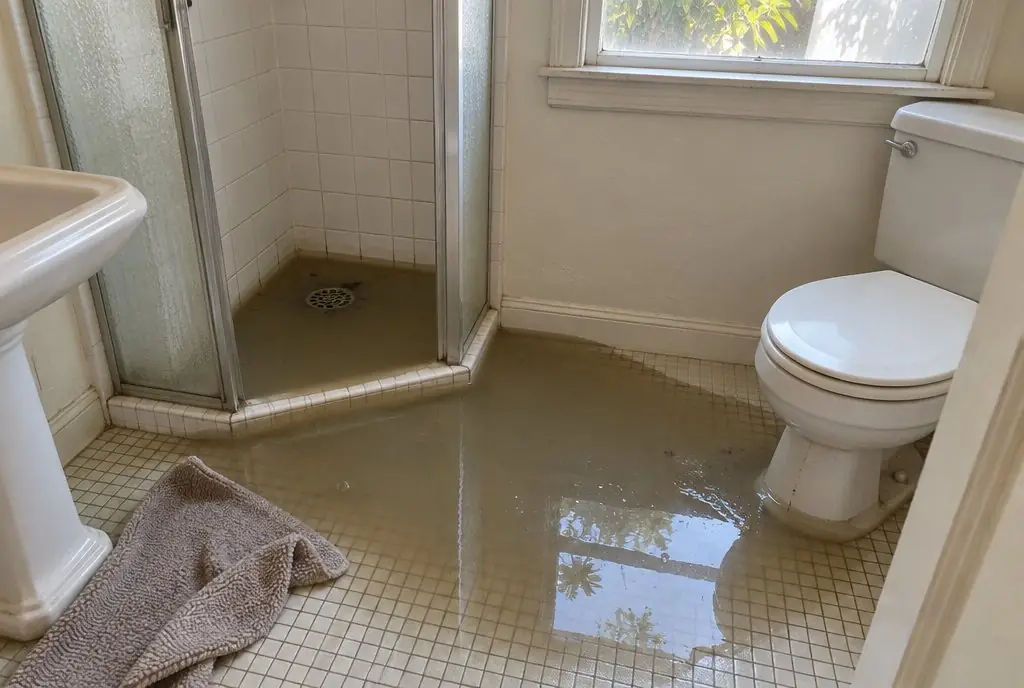
Illustrative photo.
Sewage is Category 3 water under the industry standard, so wet carpet, pad and the bottom of the drywall it touched usually come out rather than being dried in place. If roots from a parkway tree caused the backup, the city treats that as the owner's problem too, so a plumber's camera inspection is usually the next call after the cleanup.
The job, side by side
What the company does
- 1Make it safePower is cut where needed and the area is closed off; workers wear protective gear.
- 2Remove the sewageWater and solids are extracted, and porous materials it soaked, like carpet, pad and lower drywall, are cut out and bagged.
- 3Clean and disinfectHard floors, framing and fixtures are cleaned and treated with an antimicrobial.
- 4Dry and testDrying equipment runs until readings are normal; some companies test surfaces before rebuilding.
- 5Clear the lineA plumber clears or repairs the lateral, often with a camera to find roots or a broken joint.
What you do right now
- 1Stop using water anywhere in the house: no flushing, showers, laundry or dishwasher.
- 2Keep children and pets out of the area, and don't touch the water without gloves and boots.
- 3If sewage could reach outlets or cords, shut off power to that room from the panel.
- 4Call 3-1-1 (213-473-3231 from outside the city) if you think the city sewer is backing up.
- 5Photograph the water line on the walls and the drain it came from, for your own records.
Then: look the company up on the Contractors State License Board site before anyone opens a wall: work of $1,000 or more, or work that needs a permit, requires a California contractor license (Contractors State License Board: Check a License).
Los Angeles facts for this problem
The City of Los Angeles lists 3-1-1, or 213-473-3231 from outside the city, for sewer and storm drain problems.
Source: City of Los Angeles Emergency Management Department: Emergency contact numbers.
The Bureau of Engineering's long-standing rule, based on a City Attorney opinion, is that the property owner repairs and maintains the house connection from the property line to the main sewer.
Source: LA Bureau of Engineering Permit Manual: S-Permit purpose and definition.
House connections blocked by tree roots, on private property or in the public right-of-way, are the property owner's responsibility under the same rule.
Source: LA Bureau of Engineering Permit Manual: S-Permit purpose and definition.
Connecting to the city sewer takes an S-Permit from the Bureau of Engineering under Los Angeles Municipal Code 64.12, and a dye test confirms the connection.
Source: LA Bureau of Engineering Permit Manual: S-Permit purpose and definition.
About 70% of homes in the city's ZIP codes on this site were built before 1980 (Census ACS 5-year).
Source: U.S. Census Bureau, ACS 5-year, tables B25034 and B25035, calculated by Los Angeles Water Damage & Mold on November 14, 2026.
The City lists 3-1-1 (213-473-3231 from outside the city) for sewer and storm drain problems. The Bureau of Engineering's rule is that the property owner repairs and maintains the house connection all the way to the main sewer, and roots blocking it, even under the parkway, are the owner's problem too.
Sources: City of Los Angeles Emergency Management Department: Emergency contact numbers; LA Bureau of Engineering Permit Manual: S-Permit purpose and definition
Related on this site: the Los Angeles flood history for the storm days when sewers and storm drains run full, and the printable water emergency sheet for 3-1-1, LADWP and the first steps in one place.
How insurance usually treats it
Many homeowners policies exclude water that backs up through a sewer or drain unless a water backup endorsement was added, which often has its own limit. Look for 'water backup' or 'sewer backup' on your declarations page, or ask your agent, to see whether yours has it.
General information, not insurance advice. Your policy decides. See the Los Angeles water damage insurance guide for California's claim rules.
What changes the size of the job
- How many rooms the sewage reached
- How much carpet, pad and drywall has to be removed
- Whether it came from the city main or your own lateral
- How long it sat before cleanup began
- Whether the line needs repair before the house can be used
Prices aren't on this site: the company takes moisture readings in the house and writes up an itemized estimate, and the water damage estimator lists what that estimate should include.
Questions people ask
Is the city responsible for my sewer lateral in Los Angeles?
No. The Bureau of Engineering's long-standing rule, based on a City Attorney opinion, is that the property owner repairs and maintains the house connection from the property line to the main. Laterals blocked by tree roots, even in the public right-of-way, are also the owner's responsibility.
Who do I call if sewage is coming from the street?
The City of Los Angeles lists 3-1-1 for sewer and storm drain problems, or 213-473-3231 from outside the city. If sewage is already inside the house, the cleanup is a separate job from the city's work on the main.
Can sewage-soaked carpet be saved?
Usually not. Sewage is Category 3 water, and the industry standard treats carpet and pad it soaks as material to remove. Hard flooring and framing can usually be cleaned, disinfected and dried.